



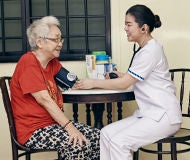



Welcome to SGH's Pulmonary Function Laboratory, where a comprehensive array of respiratory tests awaits inpatients, outpatients, and direct referrals from primary care providers and other hospitals. With a focus on quality care and advanced diagnostics, we strive to offer personalised testing solutions tailored to the unique needs of each patient.
Find out more about the tests available at the pulmonary function laboratory below.
A. Spirometry
Spirometry, the most common pulmonary function test, measures the maximal volume of air one can inhale and exhale with maximal effort. It aids in diagnosing lung diseases, monitoring lung conditions, and evaluating treatment effectiveness. Often included in pre-operative assessments.
Pre- and post-bronchodilator spirometry:
This test assesses lung function before and after bronchodilator (inhaler) administration in individuals with known or suspected respiratory conditions like asthma and COPD. Patients may need to discontinue current inhalers as advised by their physician.
What to expect:
During the test, you'll inhale deeply and then exhale forcefully into a spirometer. Volume of exhaled air and speed are calculated.
Contraindications:
Your doctor will assess your suitability for spirometry, especially if you've recently had surgery, have unstable heart conditions, recent heart attacks, ongoing respiratory infections, coughing of blood, or are in the third trimester of pregnancy.
Preparation:
Wear loose-fitting clothing, avoid large meals for at least two hours, skip heavy exercise for one hour, refrain from smoking and alcohol for at least one hour, and stop inhalers as advised.
B. Lung Volume Tests
Plethysmography:
Plethysmography measures lung capacity in an enclosed chamber (Body Box), aiding in diagnosing and monitoring COPD, asthma, interstitial lung disease (ILD), and treatment effectiveness.
What to expect:
You'll sit in a transparent chamber, performing breathing maneuvers while pressure and volume changes are measured.
Contraindications:
Assessments include claustrophobia, recent surgery, ongoing respiratory infections, inability to walk or stand without assistance, or sit upright for extended periods.
Preparation:
Wear comfortable, non-restrictive clothing and avoid tight accessories.
C. Nitrogen Washout
This test measures lung capacity by removing nitrogen gas through prolonged breathing of pure oxygen.
What to expect:
You'll inhale pure oxygen, and nitrogen concentration in exhaled breath is measured.
Contraindications:
Considerations include recent surgery, heart attack, stroke, ongoing respiratory infections, inability to seal lips over the mouthpiece, and preparation includes avoiding large meals and wearing comfortable clothing.
D. Diffusion Study
This test assesses gas exchange between lungs and bloodstream, aiding in evaluating lung function.
What to expect:
During the test, you'll inhale a gas mixture, and gas concentration in breath is measured.
Contraindications:
Considerations include mental confusion, poor coordination, or long-term home oxygen therapy.
Preparation:
Similar to spirometry preparation, including discontinuing supplemental oxygen for ten minutes.
E. Fractional Exhaled Nitric Oxide Test
The Fractional Exhaled Nitric Oxide Test is a vital tool in our pulmonary function laboratory, allowing for the measurement of exhaled nitric oxide levels. This measurement serves as a key indicator of airway inflammation, facilitating the diagnosis of asthma and enabling effective monitoring of treatment progress.
What to expect:
You'll breathe into a device measuring nitric oxide levels.
Contraindications:
Considerations include inability to seal lips over the mouthpiece or exhale continuously.
Preparation:
Avoid caffeine, alcohol, smoking, and nitrate-rich foods before the test.
F. Skin Prick Test
What to expect:
Allergen extracts are applied to the skin, and reactions are observed.
Contraindications:
Considerations include uncontrolled asthma or medications interfering with the test.
Preparation:
May include stopping antihistamine medications and avoiding topical creams.
G. Cardiopulmonary Exercise Test
The Cardiopulmonary Exercise Test evaluates heart and lung performance during physical exertion. By monitoring oxygen uptake, carbon dioxide production, and various physiological parameters, this test provides information about cardiovascular and respiratory health, guiding tailored treatment plans and exercise prescriptions.
What to expect:
Performed on a stationary bicycle with increasing exercise levels while monitoring various parameters.
Contraindications:
Considerations include recent surgery, heart attack, ongoing respiratory infections, or inability to cycle or walk.
Preparation:
Wear comfortable exercise attire and avoid large meals.
H. Exercise-Induced Asthma Test
What to expect:
Spirometry before and after exercise, usually on a treadmill.
Contraindications:
Considerations include significant airway obstruction or pregnancy.
Preparation:
Withhold medications as advised and wear appropriate attire.
I. Methacholine Challenge Test
The Methacholine Challenge Test evaluates airway hyperresponsiveness with precision to offer key information about respiratory conditions like asthma, informing tailored treatment strategies for enhanced patient care.
What to expect:
Inhalation of methacholine with lung function monitoring.
Contraindications:
Considerations include reduced lung function, pregnancy, or unstable heart conditions.
Preparation:
Wear loose clothing and withhold medications as advised.
J. Hypertonic Saline Test
Finally, the Hypertonic Saline Test serves as a pivotal diagnostic tool, meticulously assessing airway hyperresponsiveness. Administering increasing durations of hypertonic saline inhalation and closely monitoring lung function before and after, this test offers crucial data on respiratory conditions, guiding tailored treatment pathways for optimal patient care.
What it is:
Evaluates airway hyperresponsiveness by inhaling increasing saline concentrations.
What to expect:
Inhalation of saline solution with lung function monitoring.
Contraindications:
Considerations include reduced lung function, pregnancy, or unstable heart conditions.
Preparation:
Similar to other tests, including wearing loose clothing and withholding bronchodilators as advised.
Download our leaflet for further reading:
















 HealthXchange
 Health Videos


